
How to Calculate Geomembrane Quantity for a Pond
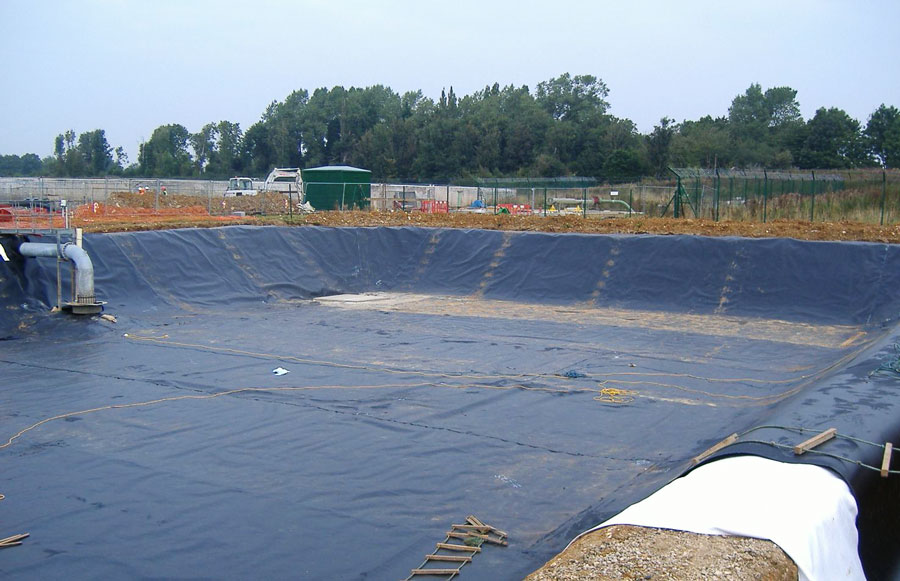
The most expensive mistake in a geomembrane purchase is rarely the price per square metre — it is getting the quantity wrong. Order too little and you run out mid-installation, with an extra seam where you did not want one. Order too much and you are left with rolls you will never use. This guide shows, step by step, how the real quantity of geomembrane for an agricultural or industrial pond is calculated.
Why the purchase figure is always larger than the pond area
Three things push the order above the bare geometric area:
- Anchor trench: the edge of the sheet has to be buried in a trench around the pond, otherwise wind and water pressure pull it in.
- Weld overlap: sheets are welded edge over edge. The GRI GM17 standard calls for at least 15 cm of overlap.
- Cutting waste: corners, slopes and off-cuts take a share of every roll.
Step 1: the measurements you need
Tools: a 30 or 50 m tape, non-stretch rope, a few marker pegs and one helper. Four simple rules: keep the tape taut, take every measurement twice, write everything in metres (12 m 40 cm = 12.4) and measure from inside the excavation, not around the outside.
Sloped-wall pond (the most common farm pond)
Take the top length and width, the bottom length and width, and the wall length along the slope. For the slope length, lay a rope on the slope surface and then measure the rope. If the bottom is full of water or mud and you cannot climb down, measure only the top dimensions and the slope angle: for every metre you drop, if the wall moves forward about one metre the slope is 45°, and if it moves about half a metre it is 60°.
Vertical-wall pond (concrete or block)
Measure length and width inside wall to inside wall, and the height from the floor to the top edge. Take the height at several points and use the largest figure.
Circular pond
Measure the diameter across the widest edge-to-edge distance, or more accurately: measure the circumference and divide by 3.14. A 44 m circumference means a diameter of about 14 m.
Step 2: calculate the covered surface
The sheet has to cover the floor plus the walls:
- Sloped: floor = bottom length × bottom width. Each wall is a trapezoid: (top length + bottom length) ÷ 2 × slope length. Do this for all four walls and add them up.
- Vertical: floor = length × width; walls = perimeter × height, i.e. 2 × (length + width) × height.
- Circular: floor = 3.14 × (diameter ÷ 2)²; wall = 3.14 × diameter × height.
Step 3: add the anchor trench
You normally need one to one and a half metres of sheet to fold into the trench. Extra area = top perimeter × anchor width. For a pond measuring 30 by 20 m at the top, the perimeter is 100 m, so a 1 m anchor adds 100 m².
Step 4: weld overlap
Geomembrane rolls come in standard widths of 2, 4, 5, 6 or 8 m. Every seam between two rolls needs 15 cm of overlap. Number of seams ≈ covered width ÷ roll width. Extra area = number of seams × 0.15 × seam length. In practice this adds roughly 2 to 4 per cent.
Step 5: the waste factor
| Project conditions | Waste factor |
| Simple rectangular pond | 11-13% |
| Large pond (over 1000 m²) | 8-10% |
| Experienced installer | 9-12% |
| Inexperienced installer or irregular shape | 18-25% |
Step 6: turn square metres into rolls
Divide the final figure by the area of one roll. A 6 m wide roll 50 m long is 300 m². Always round up to a whole roll; nobody sells half a roll.
A full worked example: farm water storage pond
A pond with a top of 30 by 20 m, a bottom of 26 by 16 m, a wall length along the slope of 3.2 m and a 1 m anchor:
- Floor: 26 × 16 = 416 m²
- Two long walls: (30 + 26) ÷ 2 × 3.2 = 89.6 m² each → 179.2
- Two short walls: (20 + 16) ÷ 2 × 3.2 = 57.6 m² each → 115.2
- Anchor trench: 100 m perimeter × 1 m = 100 m²
- Geometric total: 810.4 m²
- Weld overlap with 6 m rolls: about 27 m²
- With a 12% waste factor: about 938 m²
- Rolls of 6 × 50 m: 938 ÷ 300 ≈ 3.1 → 4 rolls
So a pond whose bare floor-and-wall area is around 710 m² actually needs close to 940 m² of sheet — exactly the gap that eyeballing the quantity misses.
What is different about industrial ponds and lagoons?
The geometry and the formulas are identical, but industrial projects add a few considerations: the sheet is usually specified thicker, its chemical compatibility with the stored fluid has to be checked, a protective geotextile is often installed underneath, and weld quality control is stricter. For lagoons and tanks with an irregular shape, use a waste factor closer to 20% instead of 12%.
Six mistakes that ruin the quantity
- Measuring the horizontal distance instead of the length along the slope — you will run short
- Measuring around the outside of the structure instead of inside
- Mixing centimetres and metres
- Forgetting the anchor trench
- Measuring only once; farm ground is never flat, so take two or three points
- A slack tape across long spans
Let the calculator do the arithmetic
Every step above is automated in the geomembrane quantity calculator: enter the pond dimensions and you get the real area including weld overlap and waste, the number of rolls and a technical PDF drawing. If you are unsure how to take the measurements, see the step-by-step pond measuring guide.
Once you know the quantity, take a look at the three-layer geomembrane sheet made by Ara Polymer Nikan, or contact our sales team.
This post is also available in:


Leave a Reply
Want to join the discussion?Feel free to contribute!